Product leadership
SquadMI
See the financial impact of squad decisions.
Connecting player agreements, financial obligations, and squad planning scenarios.

Overview
A player's cost extends beyond base salary. Bonuses, appearance incentives, transfer terms, loans, and season outcomes can all change what a club owes. Football operations and finance teams need to understand those obligations together, both for day-to-day payments and for decisions about the next squad.
SquadMI, short for Squad Management Intelligence, was developed for Pesci Sports around that problem. The product connects player agreements, financial information, and planning scenarios so users can move from an individual contract to the cost of the whole team.
This is a working demo I preserved for my portfolio. The sign-in screen includes prefilled demo credentials.
My role
My work combined product definition, UX/UI design, and delivery coordination. I helped translate operational needs into requirements, shaped the workflows and interface, and used prototypes to make product decisions concrete. I coordinated with stakeholders and engineers, and contributed AI-assisted development for prototyping and implementation.
Making contract terms usable
The product model started with structured agreement information. Legal review identified payment terms, which were organized into player scorecards and rolled up into a team financial model. The interface needed to make that detail accessible without losing the relationship between a player's agreement and the wider squad.
Player records brought contract totals and payment details into one view. From the roster, users could review individual players, their contract dates, projected costs, market values, and loan status. This provided a consistent route from a team overview into the underlying obligations.

A player record connects contract totals with the payment details behind them.
Connecting current costs with future obligations
The dashboard put wage totals, transfer fees, and total team costs alongside a player-by-player breakdown. The broader cash-flow model accounted for payment amounts, due dates, and contractual conditions. A dedicated Triggers view made conditional obligations visible, including incentives that could become payable as players reached contract milestones.
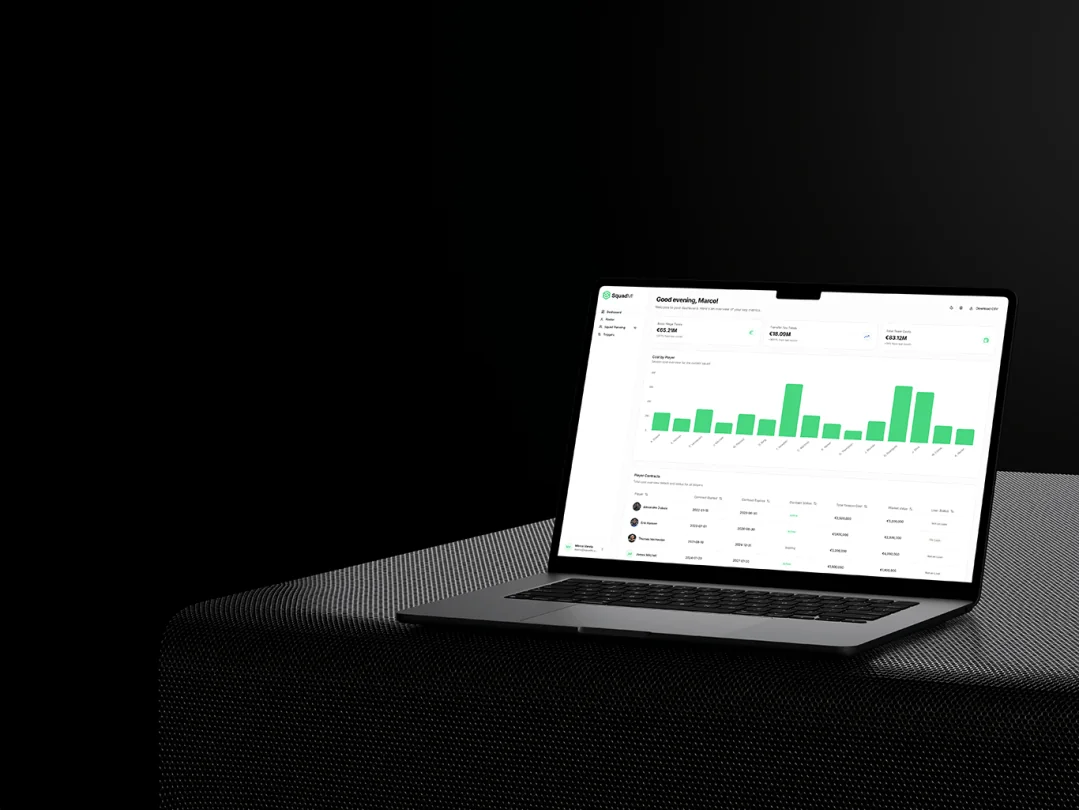
The dashboard pairs team-level totals with individual player costs and contract records.
Comparing squad decisions
Squad planning gave users a way to compare possible changes before committing to a plan. Scenarios brought incoming and outgoing players together with wages, bonuses, and transfer fees. A comparison chart and summary table showed how each scenario related to its budget.
The forecasting experience was designed to account for player usage and match or season outcomes, including promotion and relegation. These conditions matter because a squad decision can affect both the immediate budget and later contractual payments. The goal was to keep those financial consequences visible alongside the sporting choices.

The Triggers view organizes the contract conditions that can change a player's cost.
A working product experience
The work connected contract detail, financial summaries, and squad scenarios through a consistent interface. The layouts carried the same information hierarchy across desktop and mobile, keeping key totals prominent while allowing access to more detailed records.

The mobile overview preserves the financial priorities of the desktop dashboard.
The preserved demo lets you explore the dashboard, roster, contract triggers, loans, and squad planning workflows. It provides a concrete example of my contribution across product design and AI-assisted development.