Design & technology
The Genographic Project
Turning genetic ancestry data into a story.
An interactive platform translating scientific ancestry information into a personal migration journey.
Overview
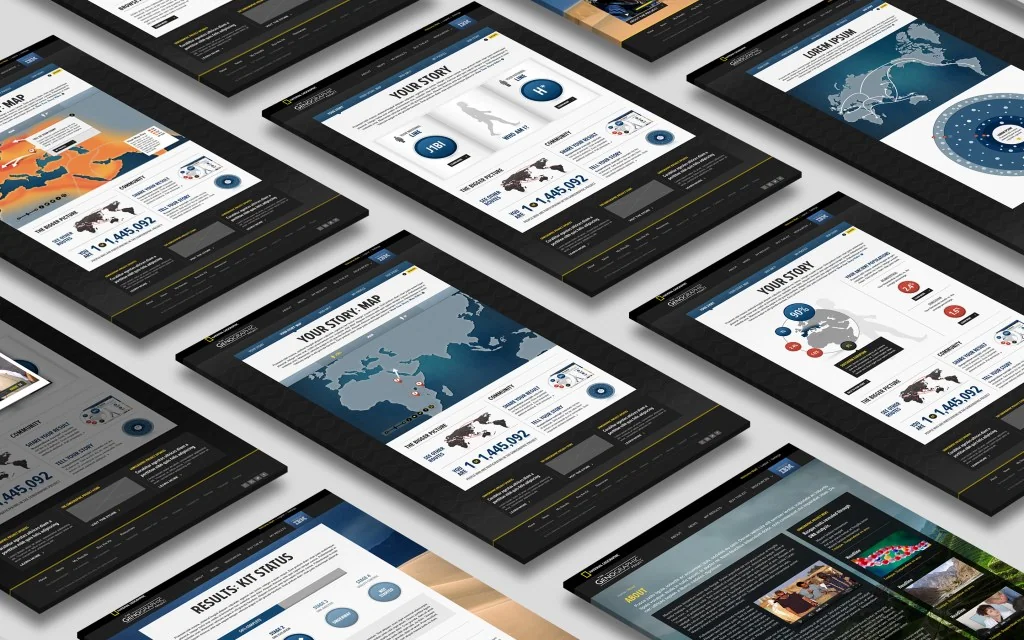
This project centered on translating complex genetic sequencing data into something the general public could understand and engage with. The goal was to support a consumer DNA initiative that allowed individuals to submit a DNA sample, receive their results, and explore their ancestral migration story through an interactive digital experience.
The challenge was to translate haplogroup and sequencing data into a meaningful narrative for people without a scientific background. The experience needed to make the information understandable while preserving its accuracy.
I led the experience work and coordinated technical delivery with stakeholders, scientists, designers, and engineers.
Understanding the Problem
Much of the scientific groundwork had already been completed. The sequencing methodologies were established, and there was existing data from global indigenous populations. What did not exist was a consumer-facing system that could responsibly present that data in a way that was engaging, accurate, and secure.
I spent time in direct conversations with the scientific team to understand the data, what it meant, and where simplification was appropriate. We also gathered stakeholder input on branding, storytelling, and long-term maintenance.
The team reviewed scientific documentation, research, visual assets, and historical context before design and development. That shared understanding helped us connect feature requirements with the scientific purpose of the project.
Because this was a novel consumer product at the time, there was no obvious template to follow. We conducted secondary research into interactive educational tools and data visualization experiences to understand what users were already familiar with, then adapted those patterns to a scientific context.
Team Structure and Leadership
The initiative involved roughly 8 to 12 contributors at a time, mostly experienced designers and engineers. I coordinated their work and helped keep the experience, science, and technical requirements aligned.
My role was to resolve ambiguity, discuss trade-offs with the team, and keep stakeholders informed as the work developed.
Key Decisions
Several early decisions shaped the outcome of the project.
First, the experience needed to feel immersive. The migration journey was visual and geographic. Static maps were not sufficient. At the time, high-resolution animated maps with smooth transitions required technology that could handle complex vector graphics and interactive states. We selected Flash for the front-end experience, which allowed us to deliver dynamic storytelling layered over detailed historical map assets.
The platform involved personal genetic information, so security was a core requirement. The engineering team built the back end on a LAMP stack, using technology it knew well.
Third, we separated the marketing-facing components from the authenticated experience. The public site introduced the product and explained the science at a high level, while the secure login area delivered each user's individualized migration journey.
I helped designers work more directly in the interactive layer, while back-end engineers focused on architecture and data integrity.
Technical and Organizational Challenges
The most significant technical challenge was data translation. The sequencing outputs were scientifically structured but not optimized for narrative presentation. We had to map raw endpoints into a story framework without distorting the science.
That required me to deepen my own understanding of genetic ancestry models. I spent time independently researching haplogroups, migration theory, and data structures so I could ask better questions and make informed decisions about representation.
Another challenge was scope clarity. In complex, multi-stakeholder environments, it is easy for ideas to evolve midstream. Early in my career, I sometimes moved forward before fully resolving ambiguities. This project reinforced a critical leadership lesson for me: never leave a room without clarity. If something is not fully understood, slow the process down and resolve it before engineering begins.
Looking back, I would prototype faster. We spent longer than necessary in design cycles before testing interaction assumptions. Today, I push for early functional prototypes to eliminate what does not work as quickly as possible.
Those lessons shaped how I lead projects now.
Launch and Handoff
The team launched an operational platform supporting kit purchases, account creation, and personalized ancestry exploration.
The engagement ended with a structured handoff and documentation to support ongoing maintenance by the responsible team.
What This Project Taught Me
The work combined scientific information, storytelling, and software delivery. It expanded how I approached the relationship between content, user experience, and technical constraints.
I learned to:
- Translate highly technical data into usable structures
- Work with engineers to choose an approach that fits the team and the problem
- Ask better questions when complexity is present
- Protect engineering teams from ambiguity by pushing for earlier clarity
- Prototype earlier and test assumptions before over-investing in polish
The project strengthened a habit I still use: resolve unclear requirements early, particularly when technical information and several stakeholder groups are involved.
It also reinforced the value of prototyping interactions earlier, before committing too much time to detailed design.